A Parent’s Guide To Track & Field
When you think of track & field, you might picture runners racing around a track, athletes jumping over hurdles, or competitors launching a shot put across a field.
But for young children, track & field looks a little different and that's exactly what makes it such a great introductory sport.
At its core, track & field is built around movements children are already naturally doing every day: running, jumping, throwing, and moving their bodies in different ways. For children ages 2–10, learning track & field isn't about running the fastest mile or perfecting a long jump. It's about developing foundational movement skills, building confidence, and discovering just how much fun their bodies are capable of having.
At Inclyousion Sports, we introduce track & field through a child-centered, play-first approach. There are no tryouts, no pressure to be the fastest, and no expectation that children already know what they're doing.
We meet them exactly where they are.
What Are the Fundamentals of Track & Field for Young Kids?
Traditional track & field includes a wide variety of running, jumping, and throwing events. With young children, we take those same fundamental movements and introduce them in developmentally appropriate ways.
Ages 2–4: Discovery & Movement
Focus: Exploring movement, body awareness, listening, and having fun
Skills introduced: Running, jumping with two feet, starting and stopping, simple throwing
What it looks like: Short races, playful obstacle courses, jumping games, throwing activities, and lots of imaginative movement
At this age, simply learning how to move their bodies in different ways is a huge accomplishment. A "race" might be running from one cone to another, and a jumping activity might involve pretending to leap over a river.
Ages 5–7: Skill Building & Coordination
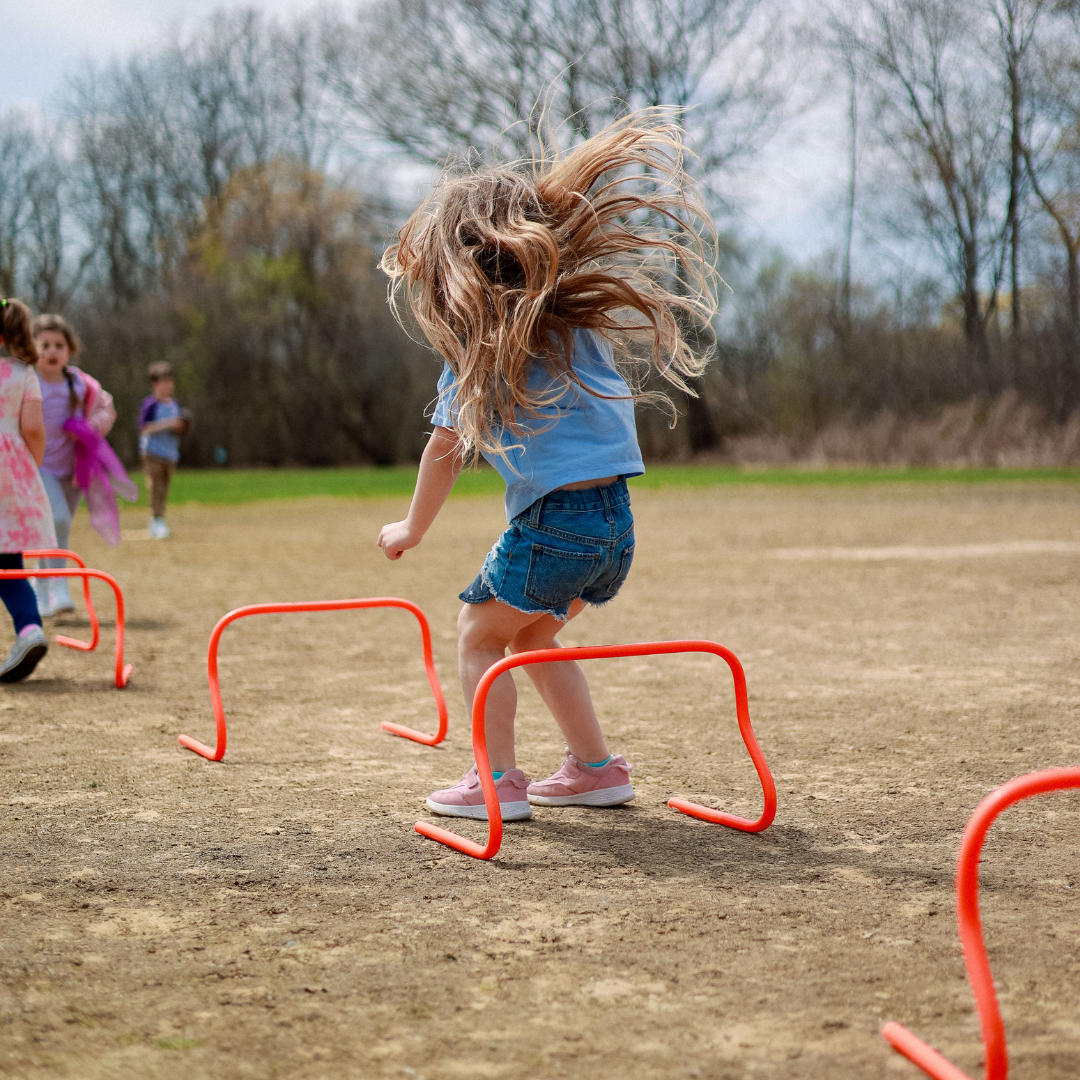
Focus: Coordination, balance, body control, and learning basic track & field concepts
Skills introduced: Sprinting, jumping for distance, introductory relay races, throwing for distance, and simple agility activities
What it looks like: Games that introduce children to different track & field events while keeping the emphasis on participation and fun
Children at this age are beginning to understand how changing the way they move can change the outcome. They can experiment with running faster, jumping farther, throwing with more control, and working with teammates during relay-style activities.
Ages 8–10: Confidence & Skill Development
Focus: Technique, coordination, sportsmanship, and personal improvement
Skills introduced: Running form, pacing, relays, jumping techniques, throwing mechanics, and more advanced agility
What it looks like: Individual and team challenges, skill stations, relay activities, and opportunities to practice improving their own performance
Older children may naturally become interested in how far they can jump or how quickly they can run. We can introduce those concepts while still keeping the focus on personal growth rather than comparison.
Why We Use a Non-Competitive Curriculum
Track & field is traditionally an individual competitive sport. Someone runs the fastest, jumps the farthest, or throws the longest.
But that's not where young children need to start.
At Inclyousion Sports, our curriculum is child-first, not competition-first. That means we prioritize:
Individual development over winning
Effort and participation over performance
Positive reinforcement over pressure
Personal growth over comparison
Encouraging teammates rather than competing against them
For a 4-year-old, success doesn't need to mean crossing the finish line first, it might mean participating in the race for the first time, or waiting for "GO!" before taking off. It might mean jumping with two feet instead of stepping over the obstacle or simply joining the group after spending the first few minutes watching from the sidelines.
Every child is starting from a different place, and that's understood and okay.
Why Track & Field Is a Great Sport for Kids Ages 2–10
One of our favorite things about track & field is its simplicity.
Children don't need to learn complicated rules or understand team positions before they can participate. They get to start with movements that already feel familiar.
Track & field can help children develop:
Gross motor skills through running, jumping, and throwing
Balance and coordination as they learn to control their bodies
Strength and endurance through active play
Body awareness as they experiment with different types of movement
Listening skills through starts, stops, directions, and games
Confidence as they accomplish new physical challenges
Social skills through taking turns, cheering for others, and participating in relays and group activities
Track & field is also incredibly modifiable. A child doesn't have to be naturally fast to enjoy it. They don't have to be able to throw farther than their peers or jump a certain distance. There are so many different ways to participate and experience success.
Track & Field Builds Skills That Transfer to Other Sports
Another reason we love introducing track & field to young children is that the skills they develop can support almost every other sport they may want to try later.
Think about it…
Soccer requires running and changing direction.
Basketball requires running and jumping.
Baseball requires running and throwing.
Football requires sprinting, agility, and coordination.
Even beyond organized sports, running, jumping, balancing, and throwing are fundamental movement skills children use throughout childhood. That makes track & field a wonderful way to build an athletic foundation without asking a young child to specialize in one sport.
Why Enrolling in Inclyousion Sports Is a Great First Step
At Inclyousion Sports, our track & field classes are designed specifically with childhood development and inclusion in mind. We know that a field full of children will never include ten kids who learn, move, communicate, and participate in exactly the same way.
Our programs include:
✅ Smaller class sizes and innovative coaching techniques
✅ Sensory-aware activities designed to support a variety of learning needs
✅ Developmentally appropriate instruction
✅ Coaches trained in inclusive strategies, youth sports best practices, and positive behavior support
✅ Activities that can be modified to help children experience success at their own level
✅ A non-competitive environment where fun comes first
Whether your child loves to race everyone they meet or would rather take their time exploring each activity, there's a place for them.
Tips for First-Time Track & Field Parents
If your child is trying track & field for the first time, here are a few simple ways to help make the experience positive:
Dress for movement: Comfortable athletic clothing and closed-toe sneakers are perfect. Don't forget water!
Skip the performance expectations: Your child's first experience doesn't need to reveal whether they're "a runner." Let them explore.
Celebrate effort: Instead of asking, "Did you win?" try, "What was your favorite thing you did today?" or "I loved watching you try that jump!"
Avoid comparisons: Young children develop physical skills at dramatically different rates. Focus on what your child is learning rather than how they compare with another child.
Give it time: New activities can feel overwhelming at first. Some children jump right in, while others need a few classes to become comfortable with the coach, environment, and routine.
Track & Field Is About More Than Running Fast
One of the most important things we can teach young children through sports is that being an athlete doesn't mean being the fastest, strongest, or "best." Being an athlete can mean being willing to try.
Ready to Get Started?
If your child loves to run, jump, throw, or simply wants to try something new, track & field might be the perfect sport to explore.
Inclyousion Sports offers inclusive, non-competitive programs designed to help children learn sports skills, build confidence, and have fun through movement.